
Games

I
One day, some time this past summer, the world twisted in on itself. Like wringing a wet towel, Northern Europe became equatorial. Folk står på brua ved Kløfta, det er over tredve grader og det er litt sånn Sør-Amerika tilstander. Thirty-one degrees celsius, people were standing on an overpass, peering over the E6 highway below them, waiting for a bus to pass by, police escorted, carrying jet lagged football players. In their luggage, there wasn’t a world championship trophy. They did not even make it to the top four. Yet, over hundred thousand people gathered to celebrate their arrival, some scattered on the aforementioned overpasses with flags and banners, the vast majority in the city center, in front of the royal castle, where King Harald V was inside, also waiting.
The cup coincided with a brutal heatwave, which I’ve come to realize I am less prepared for as the heat intensifies with each passing year. Creaking leather couch, clinging to my naked thighs, white fans swirling in a half circle. In between matches, when one is less alert and thus more vulnerable to be enveloped by the heat, thinking becomes arduous. Thought with the intention of transmuting it into words, or more ambitiously a text, seems far from my clammy hands’ reach. As a country, we’re not built for this kind of weather. Our buildings insulate warmth, it does not expel it.
This is also the case with the national football team. They are insular in the sense that they do not leave the nation, nor venture out in the continent for the European championship. Some do play in renowned clubs of course, so I am not being entirely truthful with this metaphor. Still, Norway is not exactly a football nation. We have not qualified for the world cup since 1998. The Norwegian team played against Brazil in the group stage and won somehow, an event that is as miraculous and absurd today as it was back then. The 98’ team did not go further than the round of 16, where they lost against Italy. Then nothing happened for twenty eight years.
I did not anticipate contending with my feelings around Norwegian nationalism this summer. I had lined up books about Sufism, Uzbekistan, and also some Russian literature. Hamid Ismailov, Al-Ghazali, Shahram Akbarzadeh, Osip Mandelstam. All of it got pushed to September. Instead, on my nightstand, there is Nils Henrik Smith, Dag Solstad, and Jon Michelet.
My relationship to football does not extend beyond being intrigued by the World Cup. Its specialness comes from its rarity, that there is ample space between each occurrence. Also, there are nations competing. Teams are based on historical categories, and so the rivalries are pettier, more primal. It’s not like clubs with players that are bought and traded in a marketplace, or supporters who choose their teams based on fancy instead of historical baggage.
Of course, like any self respecting writer, I am skeptical of what may cloud my criticality. Nationalism in particular is known for being poisonous. You are better off without the trail of bodies it leaves in its wake. Sooner or later our tribe always comes to ask us to agree to murder, Charles Simic said.
But then again, as Etel Adnan put it, exile is a secret wish. To wrestle out of the grip of the nation is no easy feat, especially during the World Cup, the quadrennial clench. In 1990, Solstad was relieved he did not have to participate in the insanity, implying that if Norway was qualified, he would not have any choice:
I don’t understand why people should paint their faces red and white. I think it’s embarrassing! The new modern type of supporter, I can’t be that. I’m so glad that Norway has such a bad football team that I don’t have to stand here, in white shorts and a red t-shirt, face painted red and white and blue. I’m so incredibly happy about that.
Perhaps it was the heat that made me vulnerable when this wave of collective delirium hit. Whatever the reason, please understand, we have never made it this far, ever. I realize how silly it might seem, to jeopardize one’s criticality for a game.
II
Except, of course I am. Games, as philosopher C. Thi Nguyen describes them, are their own kind of art. A game is the act of taking on unnecessary obstacles in order to experience the joy of overcoming them. Different types of art are tied to certain senses or faculties; paintings to our sense of sight, music to our sense of sound. Games are the aestheticization of agency. There is a beauty in navigating certain constraints that requires finesse, technique, agility. This is particularly evident in certain South American teams, known for playing with such fluidity it seems like a dance, like samba.
The point is to win, naturally, but it also matters how one wins. On a smaller scale, an accidental goal does stoke excitement, like Andreas Schjelderups pass which turned into a goal in the match against England. but a highly intentional one, like Antonio Nusa dribbling past several ivorians and tucking the ball in the corner of the net, is beautiful.
This beauty is not only because of the players talent, but also the games tangibility. To observe a game is a low effort high reward activity, its accessible and relatable. The World Cup is also one of few events where the world seems to be in perfect sync, a rarity given how we otherwise are fragmented geographically, as well as digitally, by way of filter bubbles and echo chambers. For several weeks, millions of people are looking at the exact same thing. Few things can achieve this.
The world is a terribly confusing place, Nguyen said once in an interview. Games work as a kind of refuge against complexity, their simplicity offers a kind of comfort. Ståle Solbakken, Norway’s head coach, mirrored this sentiment shortly after the victory against Brazil, while choking back tears, it was the first sentence stumbling out of his mouth: Vi lever i en forferdelig verden. Men vi er sammen om noe nå, og det rører meg, jeg må si det. We live in a terrible world, but we are together in this, and I must say, it moves me.
Events have a tendency of etching their specialness into your mind, making you unable to forget when and where you were when they occurred. Most Norwegians, if I may be bold enough to generalize, will remember when and where they were when Norway beat Iraq, Côte d’Ivoire, Senegal, and Brazil. These words are a fistful of flashbulb memories that I accumulated too quickly, I could barely hold them all before our momentum was halted by losing to England in the quarter finals, making me spill the content of my hands right here, on this page.
III
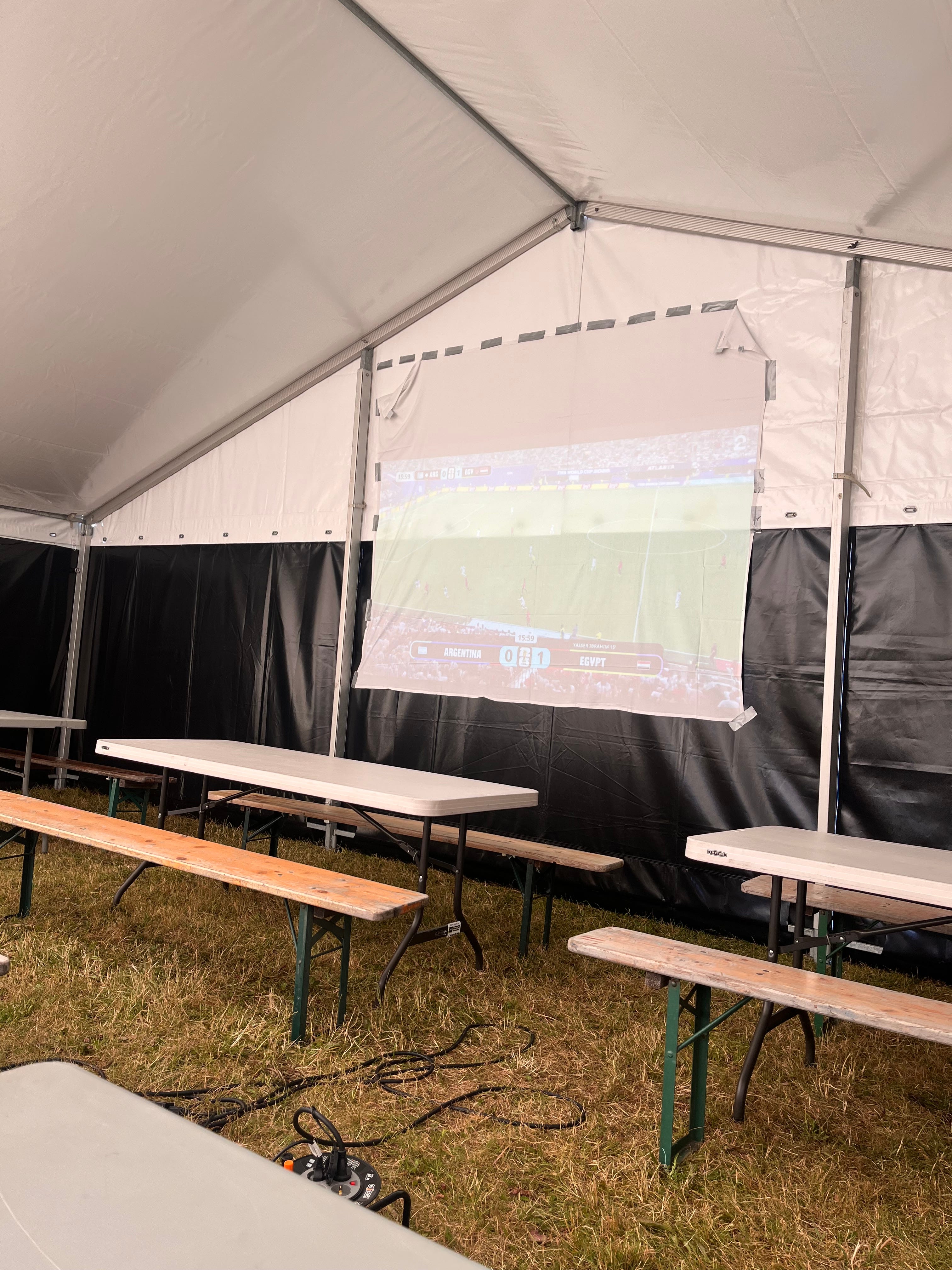
I am unsure if I share this view of games as a kind of escapism. Is it something that distracts from the world’s terribleness, or acts as a magnifying glass? I watched the infamous Argentina/Egtpt match while working at a summer camp for teens, from a white sheet duct-taped to a wall and an old projector hooked onto a computer streaming the game. When Egypt’s second goal was annulled by VAR due to a supposed foul, suspicions began swirling about the blatant favoritism of Argentina that would skew the results in their favor. But Egypt scored another one shortly after, keeping their double lead. In the second half, Argentina scored three goals, one of which should have been annulled by a foul that would have awarded Egypt a penalty. Where the intervention of VAR was swift in the first half, its absence during this blatant foul made the corruption that is rife in FIFA undeniable.
In the field of general football discourse, two teams are playing against each other. The first is football-is-not-political, and the opposing team is football-is-political.
As a faithful supporter of football-is-political, I am upset by the current strategy that treats the political nature of football as a heuristic rather than a conclusion. I.e., Football is political, I don’t agree with its politics, and so we ought not to engage with it. The heuristic implies that football is something to opt out of, because the politics of football as it stands does not cohere with one’s own values. In contrast, to conclude that football is political, is to follow the principle of falsification. In other words, the strategy is to observe the failure of the neutrality of football.
What if we draw a magic circle, and keep the world out, for ninety minutes or so? The rules of the game tell you what to care about, Nguyen says. It limits what you pay attention to, like fiction it suspends disbelief. But your immersion is repeatedly interrupted as the world imposes itself on the game, effectively breaking its spell.
The simplicity of the game works as a blank backdrop to make unfairness undeniable. The politics-averse football fan is forced to contend with corruption and the racism that interrupts the beauty of the game, it makes it easier to observe in real time how these forces operate and to trace their cause and effect. To be bothered by the introduction of hydration breaks, breeds disdain towards the commercialization of football. To be bothered by the judgments made by VAR, is to see the reification of technology, the attempt to sanitize unfairness by way of machinery, in order to give the impression of objectivity. The football fan knows that, behind those fancy computers, was the choice of mobilizing them in Argentina’s favor, and to refuse to do so, in the case of Egypt. Football then, like many other cultural phenomena, give ample opportunities to dive headfirst into the contradictions that drive the world.
IV
Maybe. I am unsure. It is, after all, very warm, and I am very vulnerable.